For more information, please fill out the form.
Better Thinking. Better Decisions. Better Judgment.
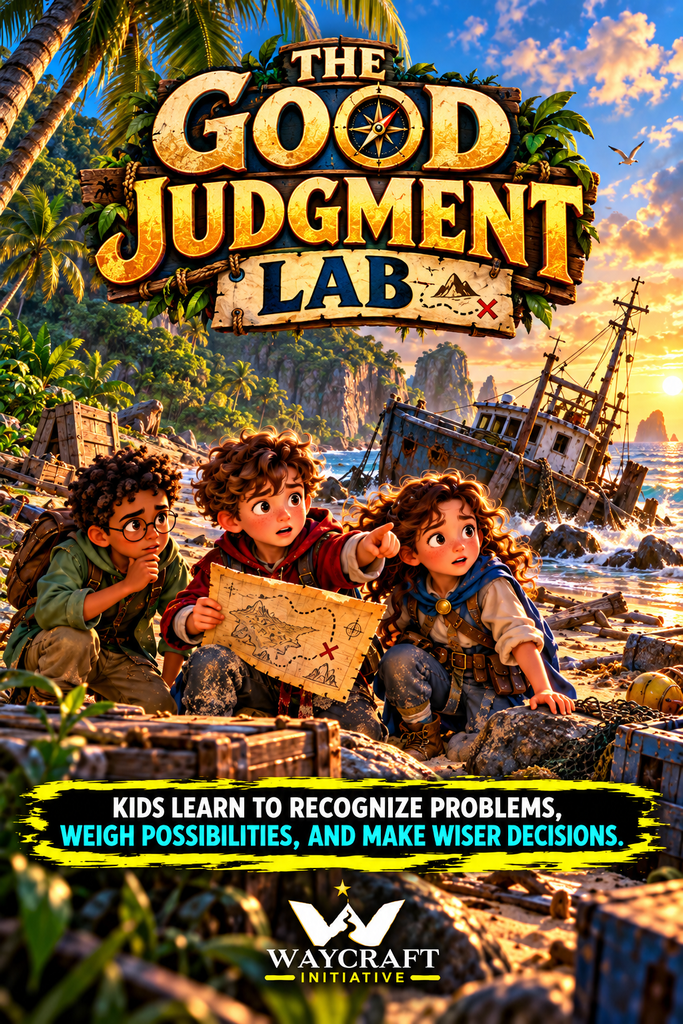
Every day, we encounter situations that require us to understand what is happening, determine what matters, consider possibilities, and decide what to do. We make judgments constantly, yet we seldom examine how those judgments are formed or how they might be improved. The Good Judgment Lab introduces students to the processes through which we recognize problems, think through possibilities, make decisions, and learn from the consequences of our actions.
The Lab is an introductory curriculum developed by The Waycraft Initiative to cultivate good judgment through guided inquiry and practical experience. Rather than treating critical thinking as a collection of abstract rules, it helps students discover the structure of their own thinking by examining situations they can understand, discuss, and investigate.
Learning to Exercise Good Judgment
Good judgment involves more than reaching correct conclusions. It requires recognizing what deserves attention, understanding the circumstances in which a problem arises, identifying relevant possibilities, and considering the consequences of different courses of action. It also requires the capacity to reconsider earlier judgments when experience reveals something we overlooked or misunderstood.
The Good Judgment Lab develops these capacities progressively. Students begin by learning to recognize and understand situations, then examine how thinking enables them to address problems and pursue desirable outcomes. As the course advances, they investigate the relationships among knowledge, values, decisions, actions, and consequences, developing a more comprehensive understanding of what it means to exercise judgment well.
Learning Through Guided Inquiry
The Lab is organized around situations and problems that invite investigation. Students are encouraged to observe carefully, identify what matters, explain their reasoning, consider alternatives, and examine the results of their thinking. Each lesson builds upon previous discoveries, allowing increasingly complex ideas to emerge from experiences that students can recognize and understand.
The teacher’s role is to guide this inquiry rather than simply provide information for students to memorize. Carefully structured questions and activities help students discover relationships for themselves, articulate their understanding, and apply what they learn to new circumstances. The curriculum provides instructional guidance so that parents and educators can facilitate this process without specialized preparation in philosophy or educational theory.
Thinking That Extends Beyond the Classroom
The capacities developed in The Good Judgment Lab are not confined to a particular academic subject. Students encounter situations requiring judgment in their studies, relationships, responsibilities, and everyday decisions. Learning to recognize problems, evaluate possibilities, anticipate consequences, and reconsider conclusions provides a foundation for engaging more intelligently with these experiences.
The Lab also introduces students to the complexity of practical judgment. Decisions are made under conditions of uncertainty, with incomplete knowledge and sometimes competing values. By examining these conditions, students begin to understand that sound judgment involves both careful thinking before action and thoughtful evaluation afterward.
A Foundation for Continued Learning
The Good Judgment Lab serves as an introduction to The Waycraft Initiative’s broader educational program. It establishes fundamental habits and capacities that students can carry into further study, more demanding problems, and increasingly complex situations.
Its central purpose is to help students become more capable of directing their own thinking and action through the deliberate cultivation of good judgment.